Habit Tracker Printable: Free 90 Day and Monthly PDF
Download the Free Printable
Download the habit tracker printable (PDF, 2 pages)
No email, no sign up. Two pages, designed to print at 100 percent on US Letter or A4:
| Page | What it is | Best for |
|---|---|---|
| 1. 90 Day Streak Tracker | 90 numbered boxes, milestones marked at 7, 14, 30, 60 and 90 days, plus a slip log | One habit you are quitting or building, such as no porn, no alcohol, a daily workout |
| 2. Monthly Habit Tracker | 12 habit rows by 31 days, plus an end of month review | Several small daily habits at once |
Print page 1 if you are trying to stop something. Print page 2 if you are trying to do several things more often. Most people who stick with this end up using both.
Why Tracking Works at All
This is not just productivity folklore. It is one of the better supported findings in behavior change research.
A 2016 meta-analysis in Psychological Bulletin (Harkin and colleagues) pooled 138 randomized studies with 19,951 participants. Interventions that got people to monitor their progress toward a goal reliably increased goal attainment. Two findings from that paper matter directly for a printable:
- Progress monitoring had larger effects when the information was physically recorded. Writing it down beat keeping it in your head.
- It also had larger effects when progress was reported or made public. A sheet on the fridge that other people can see counts.
That is exactly what a paper tracker does: a physical record, in a visible place.
How to Use the 90 Day Streak Tracker
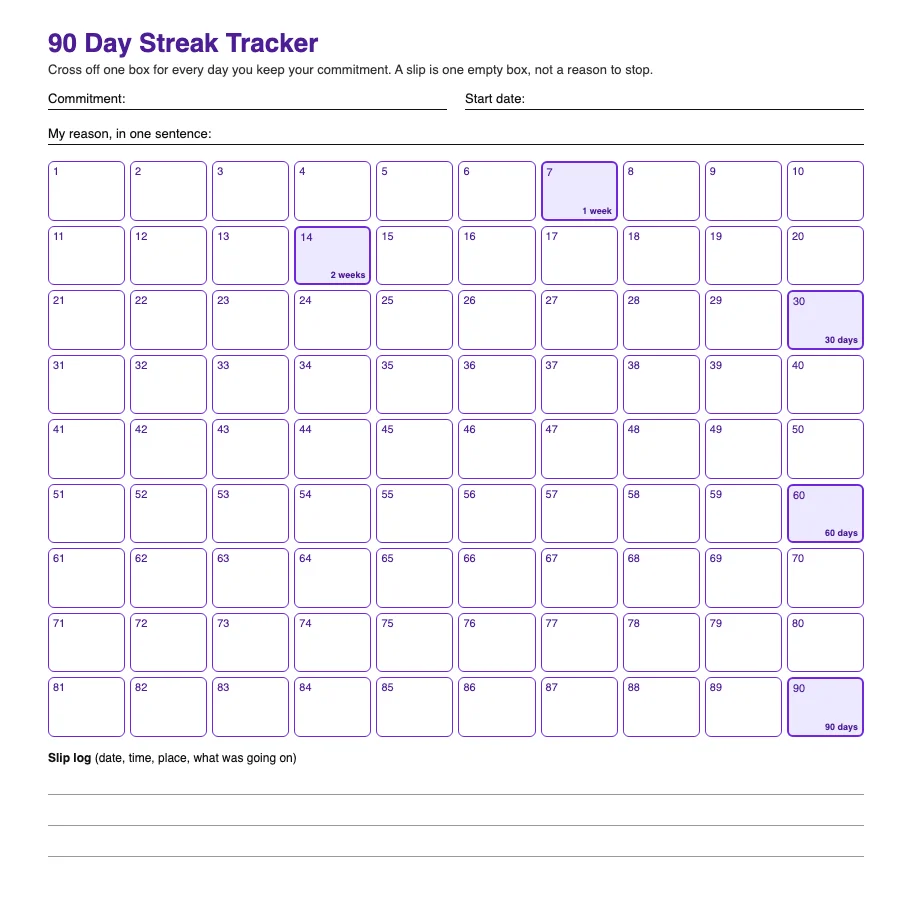
1. Fill in the three lines at the top before day one. The commitment, the start date, and your reason in one sentence. The reason line is the one you will read on the hard days, so write it for that version of you.
2. Cross off a box at the same time every day. Last thing at night works for most people, because the day is finished and the answer is known. Tie it to something you already do, like brushing your teeth.
3. Treat the shaded boxes as checkpoints. Day 7, 14, 30, 60 and 90 are marked because those are the points people tend to quit or lose interest. Notice them, and decide in advance how you will mark each one.
4. When you slip, leave the box empty and keep going. Do not start a new sheet. Write one line in the slip log: date, time, place, what was going on. After three or four entries, your pattern will usually be obvious.
5. At the end, count two numbers. Your longest streak and your slips this month. Both go at the bottom of the page.
The rule about not restarting matters more than it looks. The urge to tear up the sheet after a slip is a known psychological trap called the abstinence violation effect: one lapse feels like proof that the whole effort failed. A sheet with one empty box among sixty crossed ones is far better evidence of what is actually happening.
How to Use the Monthly Habit Tracker
Pick fewer habits than you think. There are 12 rows. Use four or five in your first month. A sheet full of empty squares is discouraging, and the point is to build momentum.
Make each habit small and binary. "Read 10 pages" works. "Read more" does not, because you cannot tell whether to fill the square.
Use the review box. At the end of the month, write what worked, what got in the way, and one change for next month. This is where the actual learning happens.
| Good habit row | Weak habit row |
|---|---|
| 20 minute walk | Exercise more |
| In bed by 11pm | Sleep better |
| No phone in the bedroom | Less screen time |
| 10 pages of a book | Read more |
| No porn | Be better |
How Long Before It Sticks
People often print a 21 day or 30 day tracker expecting the habit to be automatic at the end. The research says to expect longer.
In the most cited study on habit formation (Lally and colleagues, 2010), the median time for a simple daily habit to become automatic was 66 days, with a range from 18 to 254 days between individuals. That is why the streak tracker runs to 90 days: it covers the median with room to spare.
For quitting something, the timeline depends heavily on how long and how strongly the habit has been running. The realistic range for porn specifically is in how long it takes to recover from porn addiction.
Paper vs App: Which One to Use
Both work, for different people. Here is the honest comparison.
| Printable | App | |
|---|---|---|
| Physically recorded | Yes, which the research favours | No, but still recorded |
| Visible to others | Yes, if you put it up | Only if you show it |
| Privacy | Anyone in the house can see it | Private on your phone |
| Works when travelling | Only if you bring it | Always with you |
| Counts automatically | No, you count | Yes |
| History over months | A stack of sheets | Kept for you |
| Cost | Free | Free to download |
Our recommendation: if the habit is something you are happy for people to see, like exercise or reading, use paper on the wall. If it is private, like quitting porn, an app on your phone is usually the better choice, because a sheet on the fridge stops being an option. Many people use the printable for the first month and switch once the habit is established. The reasoning behind tracking a quit specifically is in NoFap tracker.
FAQ
Is this habit tracker printable free?
Yes. The PDF is free to download and print, with no sign up and no email.
What size paper does it print on?
It is designed for US Letter and prints cleanly on A4. Print at 100 percent, not "fit to page," to keep the boxes square.
How many habits should I track at once?
Start with four or five on the monthly page, or one on the 90 day streak page. More habits make it easier to skip the whole sheet.
What should I do if I miss a day?
Leave the box empty, write one line about what happened, and keep going on the same sheet. Starting over hides your real progress and makes quitting more likely.
How long does it take to form a habit?
In the best known study, the median was 66 days for simple daily habits, with a range from 18 to 254 days. Plan for months, not weeks.
Is a paper habit tracker better than an app?
Research found progress monitoring works better when physically recorded or shared, which favours paper. Apps win on privacy and convenience. Use whichever you will actually keep using.
Ready to Start Your Journey?
Download Celibacy Tracker and start monitoring your progress today.